About the Sustainable Finance Observatory
We focus on removing barriers to private financing
Specialised expertise in Transparency, Impact, and Bankable Sustainable Solutions.
The Sustainable Finance Observatory is an international independent think tank specialised in unlocking private finance for a sustainable transition.
Since 2025, our organisation is the result of the merger between the international think tank 2° Investing Initiative - 2DII, a pioneering organisation supporting private financiers on climate alignment and impact investing since 2012 - and the Observatoire de la finance durable, set up by the French Minister of Economy and Finance in 2019 to monitor the ESG commitments of the Paris Financial Center. Our work relies on robust financial expertise supported by former experienced bankers, sustainable finance analysts and lawyers in our team and a Scientific and Expert Committee composed of some fifty senior academics and practitioners.
The President of our board is François Gemenne, lead co-author of the 6th IPCC report.
Our activities aim to remove barriers to private financing around three fundamental pillars: Transparency, Impact and Bankable Sustainable Solutions.
Supply
Transparency
Financial institutions
Barrier
Lack of accountability for and comparability of net zero commitments, targets and broader ESG practices
- We monitor and evaluate financial institutions' practices and commitments
Impact
Financial products
Barrier
Green/impact washing and lack of consideration for retail investor sustainability preferences
- We assess the impact of financial products on the real economy using robust methodologies
- We contribute to the reorientation of financial flows towards sustainability
- We support retail investors in evaluating and choosing investments aligned with their investment preferences, while identifying greenwashing and impact washing
Demand
Bankable solutions
Real economy
Barrier
Lack of SDG and climate aligned bankable projects and creditworthy investment vehicles meeting financiers' risk-return requirements
- We develop bankable solutions and financial models to scale up project pipelines that meet investors' risk-return profiles through financial engineering
Supply
Demand
Transparency
Financial institutions
Barrier
Lack of accountability for and comparability of net zero commitments, targets and broader ESG practices
- We monitor and evaluate financial institutions' practices and commitments
Impact
Financial products
Barrier
Green/impact washing and lack of consideration for retail investor sustainability preferences
- We assess the impact of financial products on the real economy using robust methodologies
- We contribute to the reorientation of financial flows towards sustainability
- We support retail investors in evaluating and choosing investments aligned with their investment preferences, while identifying greenwashing and impact washing
Bankable solutions
Real economy
Barrier
Lack of SDG and climate aligned bankable projects and creditworthy investment vehicles meeting financiers' risk-return requirements
- We develop bankable solutions and financial models to scale up project pipelines that meet investors' risk-return profiles through financial engineering
Our objective is to act on both Transitioning finance and Financing the transition.
Our areas of expertise
We help addressing the financing gap all along the financial value chain
Our programs driving the transition



Our contribution to shaping the international agenda
The Sustainable Finance Observatory contributed to shaping the environmental agenda at the Seventh United Nations Environment Assembly (UNEA-7)
Our Deputy Executive Director, Émilie Maehara, was invited to deliver the keynote presentation on Overcoming Financial Barriers at the UNEA-7 Cities and Regions Summit.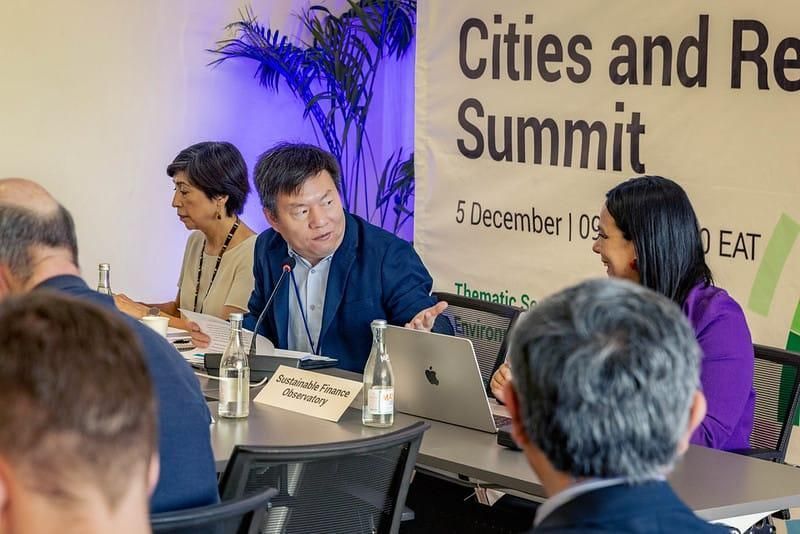
Focused on addressing the triple planetary crisis - climate change, biodiversity loss and pollution - and on strengthening synergies among Multilateral Environmental Agreements, UNEA-7 brought together more than 4,600 delegates from over 160 countries, against a backdrop of persistent systemic finance and implementation gaps. The Cities and Regions Summit convenes mayors, regional leaders and urban sustainability experts from around the world to collaborate on the most pressing environmental challenges.
Cities and regions are uniquely positioned to drive integrated local solutions that address climate, biodiversity and pollution together. They are responsible for 62% of SDG implementation and around 75% of global emissions, yet they face a systemic finance gap receiving only 10–17% of international climate finance. Émilie's keynote highlighted concrete options for how national and subnational governments, together with public and private financiers, can collaborate to:
- build multilevel technical cooperation and institutional arrangements that turn fragmented initiatives into investment-ready portfolios; and
- deploy innovative financing mechanisms and robust financial structures aligned with the risk–return expectations of different financiers.
This approach is fully aligned with the initiative Unlocking Capital with Finance Expertise Hubs, launched by the Sustainable Finance Observatory at the Fourth United Nations International Conference on Financing for Development (FfD4) and selected as part of the Sevilla Platform for Action. The initiative demonstrates how proven finance techniques can unlock capital flows for climate and SDG projects, including blended finance and co-financing mechanisms, as well as credit enhancement tools such as guarantees, including first-loss instruments.
The Sustainable Finance Observatory is strengthening its collaboration with UNEP and cities and regions networks to scale up bankable pipelines of subnational projects, with the objective of bridging the finance gap.
See the agenda: https://www.unep.org/events/summit/unea-7-cities-and-regions-summit Watch the replay from 5:20 onwards.
SFO promotes the role of financial engineering in unlocking private capital for climate action at COP30 
The Sustainable Finance Observatory participated in COP30 (10–21 November, Belém) around its President, François Gemenne. We were also present at the COP30 Local Leaders Forum (the “COP of Mayors”) and the Urban Nature Forum, held in Rio de Janeiro ahead of COP30.
We were invited to present the role of financial engineering in unlocking private capital for climate action at eight international events, organised by leading global climate action organisations, including the COP30 Presidency, UNEP, GlobalABC, ICLEI, the Global Covenant of Mayors (GCoM), Regions4, Natural Resources Defense Council, Atlantic Council, Nature4Climate, Climate-KIC, and others (see press release).
The UNFCCC and the IMF estimate that achieving the Paris Agreement and the Sustainable Development Goals will require 70–90% of financing to come from the private sector. Our work on financial engineering focuses on developing bankability models and applying financial structuring to improve the risk–return profile of projects and unlock private capital at scale. This is achieved by making more strategic use of scarce concessional public finance and increasing its leverage effect.
At COP30, our presentations, dialogues and partnership discussions focused in particular on three critical areas for mitigation and adaptation:
- energy-efficient building renovation;
- cities and regions; and
- adaptation and biodiversity.
Focus on the initiative Unlocking Capital with Finance Expertise Hubs
Selected by the United Nations among 130 high-impact solutions
Mobilising Private Finance for Development – A Practical Agenda for FfD4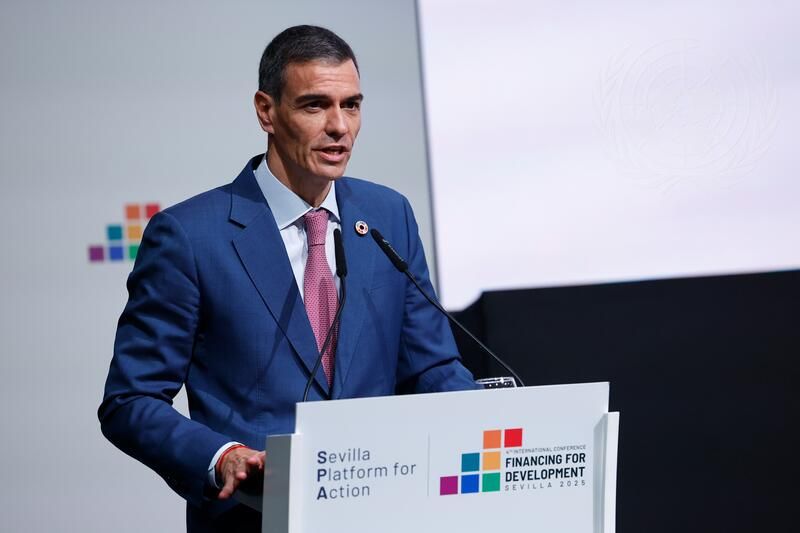
At the Fourth United Nations International Conference on Financing for Development (FfD4), the Sustainable Finance Observatory launched the initiative Unlocking Capital with Finance Expertise Hubs.
Co-authored with Dr. Barbara Samuels, Executive Director of the Global Clearinghouse for Development Finance, the report responds to a simple reality: 70–90% of the financing required to achieve the SDGs and global climate goals must come from private capital.
The initiative supports the development of country-based Finance Expertise Hubs, providing highly specialised financial expertise to scale up bankable project pipelines and unlock greater access to private finance from both domestic and international sources. It presents a scalable and immediately deployable solution to help close the SDG and climate finance gap in low- and middle-income countries.
The initiative has been selected as part of the Sevilla Platform for Action, alongside 130 high-impact global initiatives.
We are currently collaborating with UN Environment Program (UNEP), the Global Clearinghouse for Development Finance and several countries to deploy such hubs.
Credits : Pedro Sánchez Pérez-Castejón, President of the Government of Spain, addresses the launch of the Sevilla Platform for Action during the 4th International Conference on Financing for Development (FfD4).
Discover our analyses and videos on
 and
and


Annual Report SFO 2024 - Unlocking Private Capital for a Sustainable Transition
Who we work with
See all our partners here