Retail investing
There is a major market failure between EU retail investors investment preferences and the fact that only a small share actually hold impact generating financial products. Since 2017, the Sustainable Finance Observatory has been a leading authority shaping EU retail sustainable finance through research, policy engagement, product innovation (e.g. MyFairMoney) and large-scale communication.
The opportunity
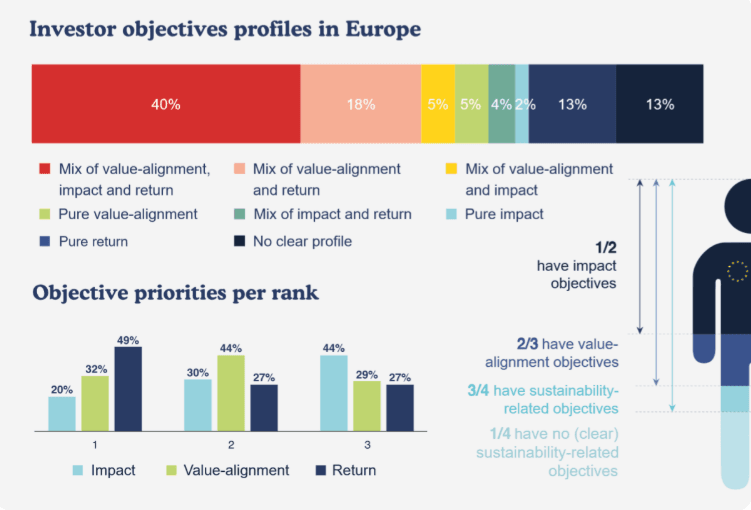
EU savers hold 1/3 of all European financial assets and represent one of the largest untapped sources of capital for the sustainable transition. The good news is interest in sustainable financial products continues to grow rapidly and 51% of EU retail investors seek investments that make a real-world difference. Mobilizing this demand through saving accounts, investment funds and pension or life insurance is one of the EU’s most powerful levers for reorienting finance towards sustainability. Yet, the system designed to match retail investor preferences with sustainable investments is not functioning as intended.
In its next phase, SFO aims to mobilize EU household savings for the transition, strengthen consumer protection, close supply–demand gaps, and guide key reforms such as SFDR, MiFID/IDD, IORPs and retail investment rules.
The problem
Despite major EU reforms (including SFDR, MiFID II and IDD), our research shows:
Retail investor demand: strong but untapped
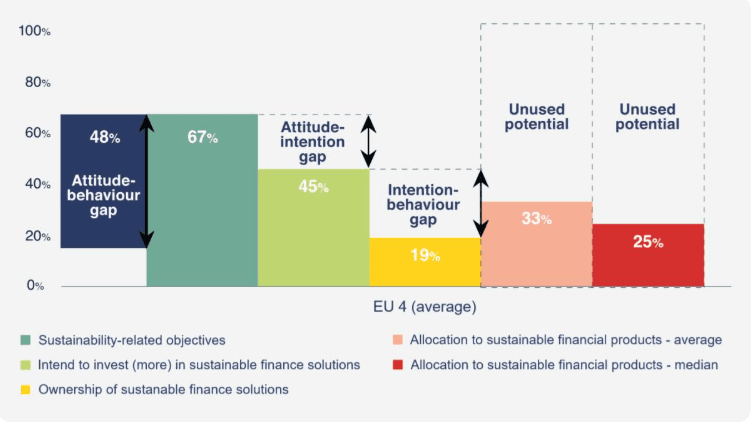
- 74% of EU retail investors have sustainability-related objectives (i.e. value alignment and/or impact), yet in key markets only 19% hold sustainable financial products, revealing a significant attitude-behavior gap.
- Despite increased average allocations towards sustainable products post-regulation, we expect that a multi-trillion EUR market remains untapped.
- Key barriers preventing retail investors from walking their talk include limited expertise, high information costs, and a lack of trust in the credibility of sustainable financial products.
A deficient advisory process
- In 57% of financial advice meetings (2022–2024), sustainability preferences were not automatically assessed.
- In 54% of German cases, advisors altered client preferences while in 53% of French cases, unsubstantiated impact claims were made.
- Advisor knowledge has improved overall but remains weak on investor impact across Member States.
Structural misallocation of impact-oriented capital
- 51% of EU retail investors want to generate real-world impact with their savings, but impact products make up only 0.7–1.3% of the market in key countries such as Germany and Austria.
- A majority of impact-oriented investors are willing to pay for real-world impact but mistakenly believe that low-carbon funds directly reduce emissions, making them vulnerable to misleading claims and potential exploitation.
- 27% of 450 Art. 8 and 9 funds reviewed in 2023 made explicit environmental impact claims — none substantiated, while 76% of investors expected real impact from such claims.
Regulatory and conceptual gaps
- The definitions of ‘sustainability preferences’ or ‘sustainable investments’ exclude impact-generating investments, misaligning with 51% of investor objectives.
- MiFID II and SFDR lack definitions for sustainability-related objectives, leading to inconsistent classification and advice.
- Oversight and enforcement remain inadequate across the EU, allowing persistent compliance failures and greenwashing risks
This undermines trust, slows the EU’s sustainable finance agenda, and prevents billions of euros from flowing to activities that support climate and environmental goals.
Our track record
Since 2017 SFO has led one of the largest retail sustainable finance research programs in the EU, analyzing demand, distribution and supply across 14 Member States. Our work has directly shaped the EU retail sustainable finance framework:
- Research: Quantitative and qualitative research on sustainability preferences of retail investors (covering 14 EU countries), surveillance of financial advisor practices (covering 15 EU countries), fund impact claim assessments across Europe.
- Policy: Influencing the Commission’s SFDR proposal on the integration of impact into new product categories, contributing to the Platform on Sustainable Finance 2.0, participating in consultation processes and working groups on sustainable finance such as EU Ecolabel, MiFID II/IDD, SFDR and PRIIPS.
- Product development: Development of the largest public platform for EU retail on sustainable finance (www.myfairmoney.eu), AI chatbot on sustainable finance, supporting robot advisor developments.
- Communication: Conferences, events and roadshows across Europe, mass campaign on traditional and social media, sustainable finance documentary, sustainable finance podcast.
We are a trusted source of insight for EU policymakers, supervisors, market participants and civil society – widely recognized for critical oversight of the retail sustainable finance ecosystem.
Our next phase
To ensure that retail investment genuinely supports the EU’s sustainability goals, we will:
- Mobilize EU savings to finance the sustainable transition through sustainable saving accounts, investment funds and pension or life insurances.
- Analyse and help address the supply-demand gaps in sustainable and impact-oriented financial products.
- Produce evidence to guide EU policymakers and supervisors during SFDR, MiFID/IDD, IORPs, SRD II and retail investment reforms.
- Advance consumer protection and safeguard an independent civil-society oversight function within the EU ecosystem.
Meet our retail investing Team

Nicola Stefan Koch
Head of Retail and Impact Investing
Nicola leads the Retail and Impact Investing research programme. In this role, he oversees research, policy engagement, product development, and communications focused on how individuals can invest sustainably and how markets can better meet retail investors’ sustainability goals. Before joining the Sustainable Finance Observatory, Nicola worked as a sustainability consultant and analyst, where he focused on sustainability strategy, performance analysis, and communication projects. He also managed development of a sustainability assessment methodology used in over 150 company analyses. He holds a master’s in international politics, Administration and International Relations from Zeppelin University (with a sustainable development focus) and a bachelor’s in international economics and development from the University of Bayreuth.

David Cooke
Law and policy Lead
David is a lawyer by training and specialises in sustainable finance and the intersection of research, policy and regulation. He has worked across international trade, emerging market finance and climate change consulting and holds a Master’s in Sustainable Development. He previously worked at ClientEarth, the UK-based public interest law firm, where he focused on regulatory and legal strategies to improve corporate and investor transparency on climate-related financial risk, and engaged with financial regulators and government departments to strengthen oversight and accountability. He joined the Sustainable Finance Observatory in 2019 and provides cross-cutting support to research programmes on legal and policy implications.

Ana Rivera Moreno
Senior Sustainable Finance Analyst
Ana is a Senior Analyst working on sustainable finance within the retail and impact team. She holds Master’s degrees in Economics and in Public Policy and Development from the Paris School of Economics, following earlier training in Economics at the National University of Colombia. Before joining the Observatory in 2022, she worked at the OECD and held analytical roles in Colombian public institutions, including the Ministry of Trade and the National Planning Department, where she contributed to empirical analysis and policy work on labour markets, industrial development, productivity, and inclusive growth. At the Observatory, she leads and contributes to quantitative and qualitative analysis, survey-based research, and the development and maintenance of MyFairMoney.