Advocacy and coalitions
The Sustainable Finance Observatory is actively engaged in advocacy efforts to unlock private capital for the transition, both in international debates and in dialogue with European institutions. We provide in-depth regulatory and policy analysis, along with concrete recommendations on how to strengthen sustainable finance frameworks and develop effective financial solutions.
Advocacy
On the Financing the transition pillar, the Sustainable Finance Observatory has received recognition from the United Nations for solutions based on deployment of financial engineering to unlock capital, through both national institutional arrangements and innovative financing models.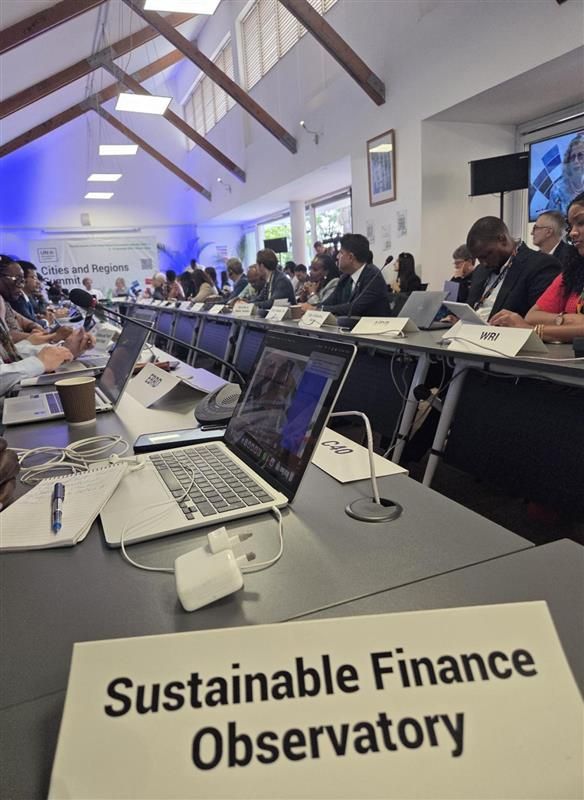
At the Fourth United Nations International Conference on Financing for Development (FfD4), we launched the initiative Unlocking Capital with Finance Expertise Hubs. Co-authored with Dr. Barbara Samuels, Executive Director of the Global Clearinghouse for Development Finance, the report responds to a simple reality: 70–90% of the financing required to achieve the SDGs and global climate goals must come from private capital.
The initiative supports the development of country-based Finance Expertise Hubs, providing highly specialised financial expertise to scale up bankable project pipelines and unlock greater access to private finance from both domestic and international sources. It presents a scalable and immediately deployable solution to help close the SDG and climate finance gap in low- and middle-income countries.
The initiative has been selected as part of the Sevilla Platform for Action, alongside 130 high-impact global initiatives.
The Sustainable Finance Observatory is currently collaborating with UN Environment Program (UNEP), the Global Clearinghouse for Development Finance and several countries to deploy these Finance Expertise Hubs, within an initiative of the Activation Group No. 13 of the COP30 Presidency’s Action Agenda.
On innovative financing models, the Sustainable Finance Observatory promotes the quantification and monetisation of avoided costs and co-benefits to unlock private capital for adaptation and biodiversity, which continue to face a structural financing gap. Since New York Climate Week in September 2025, we have contributed to shaping the COP30 Presidency’s FINI initiative (Fostering Investable National Planning and Implementation), which focuses on financing National Adaptation Plans.
On the Transitioning finance pillar, we have actively contributed to shaping the European sustainable finance agenda over the past decade. Our work includes providing detailed analysis, evidence and policy briefs, as well as promoting methodologies and tools for EU and national policymakers, financial regulators and supervisors. The Sustainable Finance Observatory played a leading role in co-initiating the first climate-related financial regulation in Europe - Article 173 of France’s Energy Transition Law (2015), later strengthened by Article 29 of the Energy-Climate Law (2021) - which made climate-related reporting mandatory for asset owners and asset managers.
In terms of methodologies and tools, the Sustainable Finance Observatory contributed to development of the PACTA tool, which measures the alignment of financial portfolios and has become a reference methodology used by over 3,000 financial institutions in more than 90 countries. It has also been adopted by supervisory authorities and central banks, including the European Central Bank, to assess the alignment of regulated entities. Between 2020 and 2022, more than 30,000 portfolios were assessed using PACTA. We also played a key role in the design of the ISO 14097 standard, which provides a general framework for financial institutions to assess, measure, monitor and report on investments and financing activities related to climate change and the low-carbon transition.
As a member of the EU Platform on Sustainable Finance from 2024-25, the Sustainable Finance Observatory actively contributed to working groups providing advice to the European Commission, notably on recent work related to SFDR.
We help shape EU sustainable finance regulation, including the implementation of MiFID II requirements introducing mandatory assessments of client sustainability preferences, as well as the ongoing implementation and review of the SFDR framework. In this review, our focus is on ensuring the proper integration of a robust and accurate conception of investor impact.
Sustainable Finance Observatory at COP30 - Mobilising private finance for climate action was identified as “the greatest challenge” by the COP30 Circle of Finance Ministers
The Sustainable Finance Observatory participated in COP30 in Belém with our President, François Gemenne and were present at the COP30 Local Leaders Forum and the Urban Nature Forum, held in Rio de Janeiro ahead of COP30. We were invited to present the role of financial engineering in unlocking private capital for climate action at eight international events organised by leading global climate action organisations (including the COP30 Presidency, UNEP, GlobalABC, ICLEI, the Global Covenant of Mayors, Regions4, Natural Resources Defense Council, Atlantic Council, Nature4Climate, Climate-KIC and others). As highlighted in the report Unlocking Capital with Finance Expertise Hubs, which draws on best practices from developing and emerging economies, proven financial techniques can significantly mobilise capital for climate and SDG a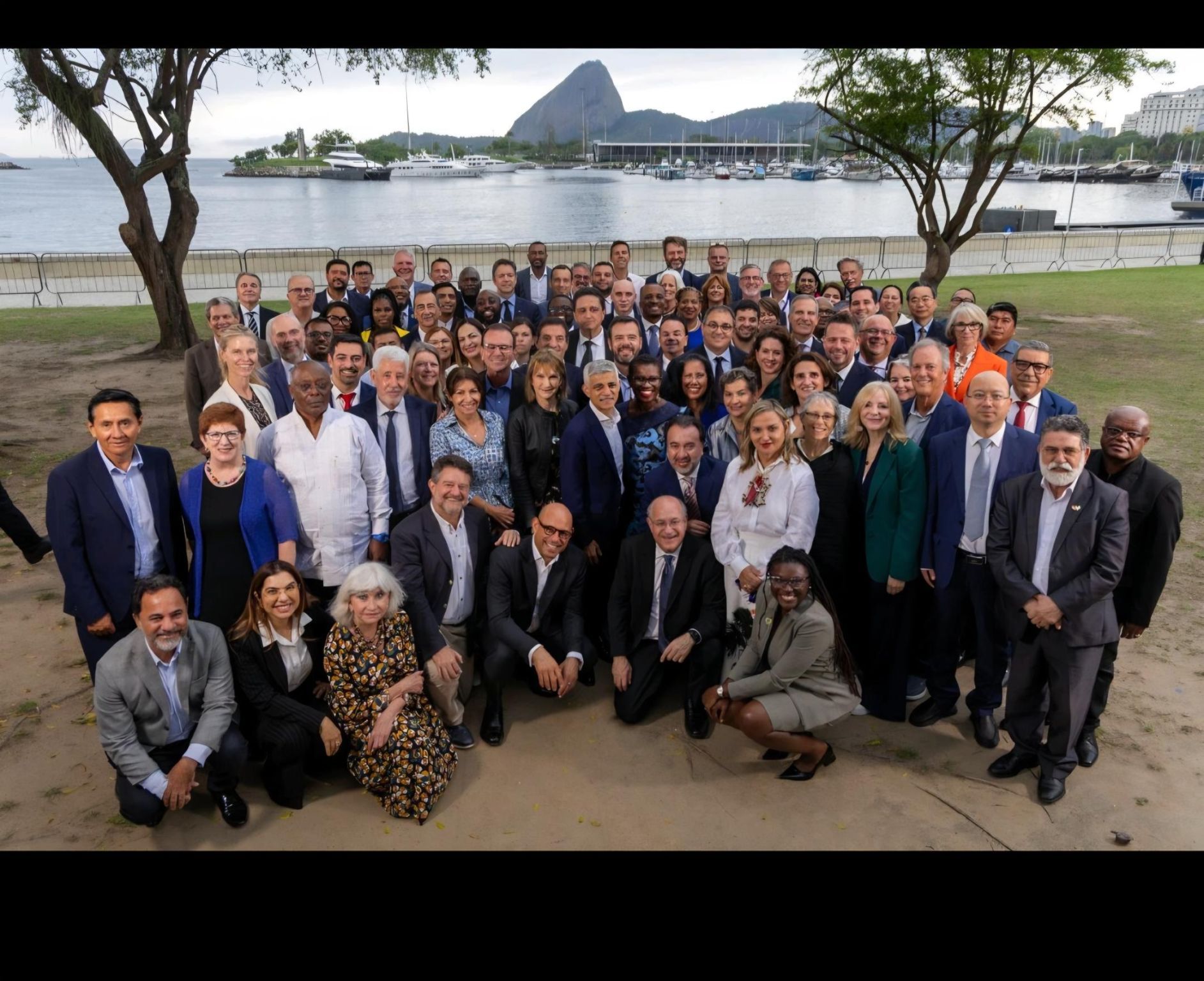 ction. These include blended finance and co-financing mechanisms, as well as credit enhancement tools such as guarantees, including first-loss instruments. Together with the Global Clearinghouse for Development Finance, we also contributed to the UNFCCC consultation on the Baku to Belém Roadmap to USD 1.3 trillion.
Emilie Maehara, our Deputy Director contributes as a Technical Expert to the work of the UNFCCC Standing Committee on Finance. At COP30, SFO’s presentations, dialogues, and partnership discussions focused in particular on three critical areas for mitigation and adaptation:
- energy-efficient building renovation;
- cities and regions; and
- adaptation and biodiversity.
Financing energy-efficient building renovation
The building sector accounts for nearly one third of energy consumption and greenhouse gas emissions in Europe.
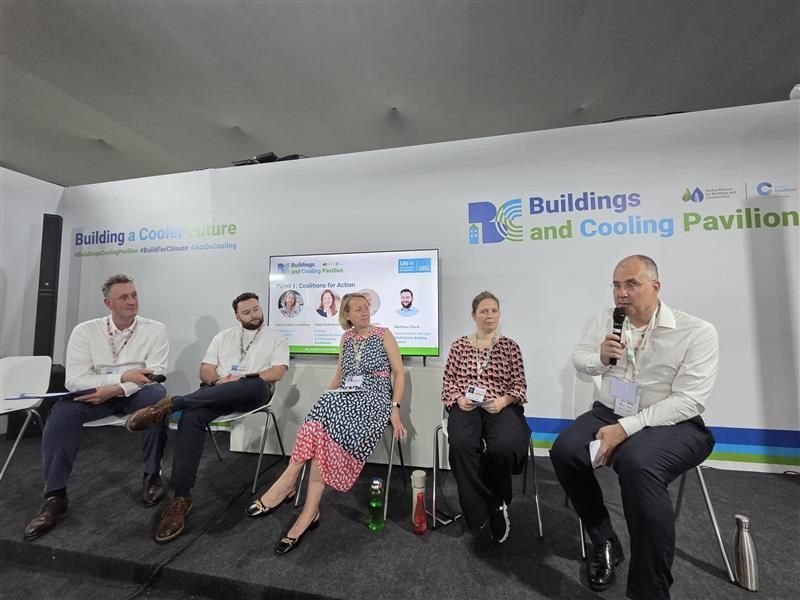
During a GlobalABC event, we presented the results of the Multistakeholder Platform on Financing Energy-Efficient Building Renovation in France, which it co-led with ADEME under the FiReno+ project. Through an operational dialogue involving more than 150 participants -including the six largest commercial banks in France - the platform supported the co-design of turnkey, replicable financing solutions capable of mobilising over €6 billion in additional private financing per year. For more information, see the project presentation: FiReno
The Sustainable Finance Observatory is a member of GlobalABC - the Global Alliance for Buildings and Construction - dedicated to advancing energy-efficient building renovation worldwide.
Cities and regions at the frontline of climate action
Cities and regions are on the frontline of climate impacts. They are responsible for 75% of global greenhouse gas emissions, yet face a major structural finance gap: current financial flows cover only 19% of urban mitigation needs, with an even wider gap for adaptation and nature finance, where projects often lack direct revenue streams. In preparation for COP30, the Sustainable Finance Observatory collaborated with UNEP on an initiative developed in partnership with the Brazilian Ministry of Cities, under Activation Group No. 13 of the COP30 Presidency’s Action Agenda: “Resilient Urban Development, Mobility and Infrastructure.” At the COP30 Local Leaders Forum, we were invited to present inspiring examples of subnational projects from emerging and developing countries that successfully attracted capital at scale through the use of proven financial techniques, during a COP30 Presidency event chaired by Brazil’s Minister of Cities.
We were also invited at COP30 to provide financial insights during a pitching session on subnational resilience projects in Latin America & the Caribbean and Africa, organised by Nature4Climate and Regions4 in the context of the launch of the Just Resilience Action Platform (JRAP). Emilie Maehara was appointed as a Reviewer of the IPCC Special Report on Climate Change and Cities.
Advancing adaptation finance and nature-based solutions
Adaptation was a central focus of COP30, marked by the commitment to triple global adaptation finance. Since New York Climate Week in September 2025, the Sustainable Finance Observatory has contributed to shaping the COP30 Presidency’s FINI initiative (Fostering Investable National Planning and Implementation), which focuses on financing National Adaptation Plans. Our contributions emphasise the importance of accounting for avoided losses and co-benefits in adaptation finance models, in line with its work under the RISE-IN project, which aims to define bankability models for nature-based solutions for flood prevention.
Coalitions
The Sustainable Finance Observatory engages in collective intelligence-driven initiatives such as technical working groups, stakeholder networks, and advocacy coalitions. Below are some of the structures we are involved in:
Coal Transition Commission (CTC) of the Coal Transition Accelerator (CTA), hosted by Powering Past Coal Alliance (PPCA)

Emilie Maehara
Deputy Executive Director
Emilie Maehara is the Deputy Executive Director of the Sustainable Finance Observatory. She has more than 20 years of experience in the fields of diplomacy, climate and finance. She worked on mobilizing climate finance in several city networks as Head of Finance Engagement and Partnerships for the C40 x GCoM Bloomberg Philanthropies Joint Programme and Deputy Executive Director of the Global Fund for Cities Development - FMDV. She previously held various position in the French public administration (Diplomat, Ministerial Advisor, Head of the Environment office at the Prefecture of Seine-Saint-Denis).

Guillaume Lorentz
Head of bankable sustainable solutions
Guillaume Lorentz has over 20 years of experience in the financial sector, including senior roles at major investment banks such as HSBC. After five years working in market and model risk management, he spent 15 years in trading as a director in Paris and London, focusing primarily on structured products for global portfolios. His financial expertise has since expanded into sustainable finance, with a strong emphasis on the bankability of sustainable solutions through financial engineering. He has extensive implementation experience across fifteen countries in Africa, particularly in energy efficiency, sustainable cities, and carbon markets. At the Sustainable Finance Observatory (SFO), he leads the Bankability and Modelling Division, covering adaptation, biodiversity, energy, and climate-related topics.

David Cooke
Law and policy Lead
David is a lawyer by training and specialises in sustainable finance and the intersection of research, policy and regulation. He has worked across international trade, emerging market finance and climate change consulting and holds a Master’s in Sustainable Development. He previously worked at ClientEarth, the UK-based public interest law firm, where he focused on regulatory and legal strategies to improve corporate and investor transparency on climate-related financial risk, and engaged with financial regulators and government departments to strengthen oversight and accountability. He joined the Sustainable Finance Observatory in 2019 and provides cross-cutting support to research programmes on legal and policy implications.